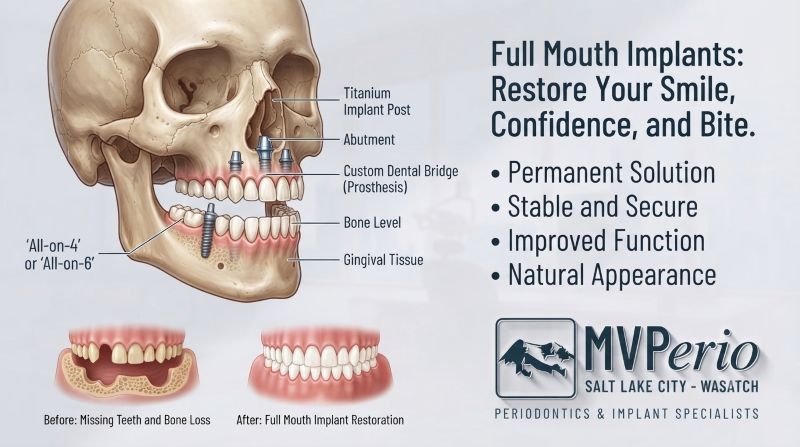
Full mouth dental implants can replace most or all missing teeth with a fixed, implant-supported restoration designed to restore chewing function, stability, and appearance. Treatment usually involves detailed imaging and planning, implant placement, a healing period, and a final restoration. The exact approach depends on your bone, gums, remaining teeth, bite, and overall oral health.
For someone who has lost many teeth, is struggling with loose dentures, or has teeth that can no longer be predictably restored, full-arch implant treatment can offer a stable alternative. But it is not one-size-fits-all. The number of implants, need for bone grafting, type of restoration, and treatment timeline should all be determined after a thorough clinical evaluation.
What Are Full Mouth Dental Implants?
Full mouth dental implants are used to replace an entire upper arch, lower arch, or, in some cases, both arches. Instead of replacing every missing tooth with an individual implant, several strategically positioned implants can support a fixed bridge or full-arch restoration.
A typical full-arch approach may use four to six implants, although the exact number depends on the patient’s anatomy and treatment goals. The implants act as artificial tooth roots and integrate with the jawbone, providing a stable foundation for the replacement teeth.
At MVPerio, treatment planning begins with an assessment of the teeth, gums, jawbone, bite, and available space for the final restoration. CBCT imaging can provide detailed three-dimensional information about the bone and surrounding structures, helping us plan implant position rather than relying only on a two-dimensional dental X-ray.
This distinction matters because replacing teeth is only one part of successful implant treatment. The supporting bone and gum tissues also need to be healthy enough to maintain the implants over time.
Full Mouth Dental Implants Procedure: What to Expect
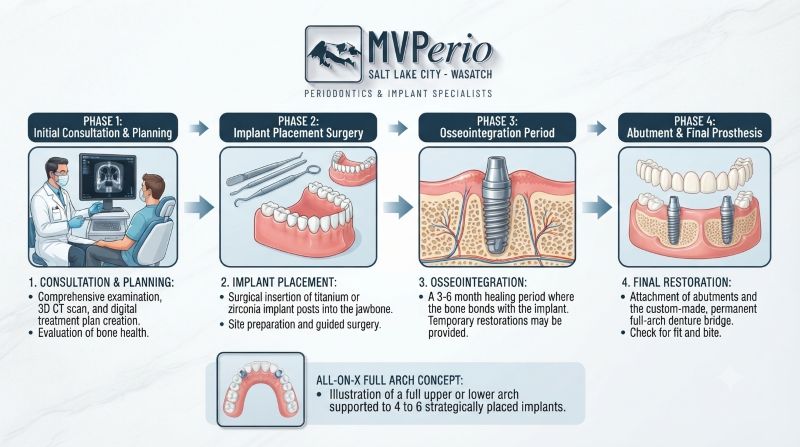
The full mouth dental implants procedure usually involves several stages rather than one isolated appointment. Your timeline depends on the condition of your teeth, gums, bone, and the type of final restoration planned.
For more information about MVPerio’s implant treatment approach, you can also explore our full mouth dental implants and dental implant treatment information.
1. Examination and treatment planning
The first step is a detailed examination.
We assess:
- The condition and prognosis of your remaining teeth
- Gum and periodontal health
- Jawbone volume and density
- Your bite and jaw relationship
- Existing dentures or restorations
- Your medical and dental history
- Your functional and aesthetic goals
CBCT imaging may be used to provide a three-dimensional view of the teeth, bone, and surrounding anatomy. This information can be particularly helpful when planning multiple implants.
The purpose of this stage is to identify potential problems before surgery and develop a treatment plan that makes biological and restorative sense.
2. Tooth removal and site preparation
Some patients seeking full-arch implants still have teeth that need to be removed because they are severely damaged, infected, or have a poor long-term prognosis.
However, removing teeth simply because implants are being considered is not always appropriate.
When a natural tooth can be predictably maintained, preserving it may be the better option. Our approach is therefore to evaluate each tooth individually rather than automatically replacing every remaining tooth with an implant.
3. Bone evaluation and grafting when necessary
Missing teeth, periodontal disease, infection, and trauma can all contribute to jawbone loss. Insufficient bone can affect where implants can be placed and whether additional preparation is needed.
If bone volume needs to be improved, bone grafting may be recommended before or during implant treatment.
You can learn more about this part of treatment through MVPerio’s bone grafting and bone loss treatment information..
Bone grafting does not necessarily mean implant treatment is impossible. Instead, it may be part of creating a healthier and more suitable foundation for future implant placement.
4. Implant placement
Dental implants are surgically placed into carefully planned positions within the jawbone.
The number and position of implants depend on:
- Available bone
- Bone quality
- Gum health
- The planned restoration
- Bite forces
- Functional requirements
- Overall treatment goals
In selected cases, an implant may be placed at the same appointment as a tooth extraction. However, immediate implant placement is not appropriate for everyone. Clinical findings at the extraction site determine whether this is a predictable option.
5. Temporary teeth and healing
Some patients may be candidates for a provisional fixed restoration during the healing period.
This is sometimes described as a “same-day” or “teeth-in-a-day” approach. However, receiving temporary teeth quickly does not mean the implants have completely healed on the same day.
The implants still need time to integrate with the surrounding bone.
MVPerio notes that implant healing typically occurs over several months, with final restoration coordinated with the restorative dentist once healing and implant stability are appropriate.
6. Final restoration
After appropriate healing, the final implant-supported restoration is fabricated and fitted.
The restoration needs to do more than look natural. It should also function comfortably, work with your bite, and allow you to maintain good oral hygiene around the implants.
That is why restorative planning is an important part of the treatment from the beginning rather than something considered only after implant surgery.
Full Mouth Dental Implants Cost: What Determines the Price?
The full mouth dental implants cost can vary substantially between patients because the treatment itself can vary substantially.
There is no single price that accurately represents every full-mouth implant case.
The total cost may be influenced by:
- Number of implants required
- Whether one or both arches are being treated
- Tooth extractions
- Bone grafting
- Gum or soft-tissue procedures
- Type of temporary restoration
- Material used for the final restoration
- Complexity of the bite
- Diagnostic imaging and planning
- Sedation requirements
- Long-term maintenance
For example, a patient with adequate bone and healthy gum tissue may require a very different treatment plan from someone who has extensive bone loss or active periodontal disease.
This is why comparing treatment solely by an advertised starting price can be misleading. Two treatment plans may have different costs because they include different numbers of implants, procedures, restorative materials, or levels of surgical complexity.
For an overview of MVPerio’s implant treatment options, including full-arch and All-on-4 approaches, visit the MVPerio dental implants page.
Full Mouth Dental Implants Recovery: What Is the Healing Process Like?
Full mouth dental implants recovery occurs in stages rather than ending immediately after surgery.
You may experience swelling, tenderness, or temporary changes in chewing and speaking during the initial healing period. These symptoms generally improve as the tissues recover, but the exact experience varies depending on the number and complexity of procedures performed.
The deeper healing process is more important. The implants need time to integrate with the surrounding bone before the final restoration is placed.
If bone grafting is necessary, the overall treatment timeline may become longer because the grafted area may need additional healing before or during implant placement.
During recovery, we typically focus on:
Following the specific post-operative instructions provided to you
- Maintaining appropriate oral hygiene
- Avoiding unnecessary pressure on healing areas
- Attending scheduled follow-up visits
- Following dietary recommendations during the early healing period
- Reporting anything unusual rather than trying to manage it yourself
Your recovery timeline should therefore be based on your actual procedure rather than an advertised “teeth in a day” timeline. A temporary restoration may provide teeth quickly, but biological healing still takes time.
How Long Do Full Mouth Dental Implants Last?
If you are wondering how long do full mouth dental implants last, the answer depends on both the implants and the restoration they support. Dental implants can remain functional for many years, but they are not maintenance-free, and the supporting tissues remain important throughout their lifetime.
Research on full-arch fixed implant restorations has reported high short-term survival rates, although the researchers also noted that reliable long-term evidence has historically been more limited.
For a more detailed discussion of implant longevity, see our guide on how long dental implants really last.
Several factors can influence long-term implant stability, including:
- Gum and periodontal health
- Oral hygiene
- Smoking
- Bone quality and quantity
- Bite forces
- Implant positioning
- Restoration design
- Regular professional maintenance
- General health and individual healing factors
Importantly, the implant itself and the teeth attached to it are not necessarily expected to have identical lifespans. The prosthetic teeth may require repair, adjustment, or replacement before the underlying implants do.
Long-term studies also show why implant maintenance matters. Biological complications such as inflammation around implants and technical complications involving implant-supported restorations can occur over time.
All on 4 vs Full Mouth Dental Implants: What’s the Difference?
When comparing all on 4 vs full mouth dental implants, it helps to understand that these terms can describe overlapping treatment concepts rather than completely separate categories.
All-on-4 is a specific full-arch treatment approach in which an entire arch of replacement teeth is supported by four strategically positioned implants.
A broader full-mouth or full-arch implant treatment may use four, five, six, or another number of implants depending on the patient’s anatomy and restorative requirements.
When might All-on-4 be considered?
All-on-4 can be appropriate for selected patients because strategically positioned implants can make use of available bone and may reduce the need for extensive grafting in certain cases.
However, it is not automatically the best choice for every patient.
When might more than four implants be considered?
Some patients may benefit from a different number or configuration of implants.
Additional implants may be considered based on:
- Bone availability
- Distribution of chewing forces
- Restoration design
- Arch anatomy
- Functional requirements
- Long-term maintenance considerations
The important question is therefore not simply “four or six?” It is “which implant configuration provides the most appropriate foundation for my particular situation?”
You can review MVPerio’s full-arch, All-on-4, and All-on-6 implant options for more information.
Who May Be a Candidate for Full Mouth Dental Implants?
Full-arch implant treatment may be considered for patients who have:
- Lost most or all of their teeth
- Multiple teeth with poor long-term prognosis
- Difficulty wearing conventional dentures
- Significant difficulty chewing
- Tooth loss associated with periodontal disease
- Adequate bone or the possibility of creating an appropriate implant foundation
But being interested in implants does not automatically mean you are ready for implant placement.
Active gum disease, inadequate bone, certain medical factors, smoking, and uncontrolled oral inflammation may affect treatment planning and implant prognosis. A specialist evaluation helps identify these issues before surgery rather than after problems develop.
Our approach is conservative: when a natural tooth can be predictably preserved, we believe that option deserves consideration before replacing it with an implant.
DR. Hegde’s and DR. Thunell’s Clinical Perspective
When we evaluate a patient for full-arch implants, we do not begin by asking, “How many implants can we place?”
We begin by asking whether implant treatment is actually the right solution and what foundation will be needed to make it predictable.
In our experience, the most important part of complex implant treatment happens before surgery. We need to understand the condition of the gums and bone, the prognosis of any remaining teeth, the patient’s bite, and how the final restoration will function.
We also believe that a patient’s expectations should be part of the clinical discussion. A treatment that looks excellent initially but is difficult to clean or maintain is not a successful long-term plan.
For us, the objective is not simply to give someone a fixed set of teeth. It is to create an implant-supported restoration that can be maintained, monitored, and supported for years.
That is why we may recommend periodontal treatment, extraction, bone grafting, or a different implant configuration before proceeding with full-arch treatment. Sometimes the most appropriate treatment is more conservative than the patient initially expected.
Frequently Asked Questions About Full Mouth Dental Implants
Choosing full-arch implants involves several decisions, so patients commonly ask about cost, treatment time, recovery, longevity, and the difference between implant approaches.
Q. Are full mouth dental implants permanent?
Dental implants are designed to be a long-term tooth replacement solution, but “permanent” should not be interpreted as maintenance-free. Implant survival depends on factors such as bone and gum health, oral hygiene, bite forces, smoking, and regular professional care. The prosthetic teeth may also require maintenance or replacement over time.
Q. How long does the full mouth dental implants procedure take?
The surgical portion can vary from patient to patient. The overall treatment may take considerably longer because implant placement is only one stage. Extractions, bone grafting, healing, provisional teeth, and fabrication of the final restoration can all affect the timeline.
Q. How painful are full mouth dental implants?
Patients may experience soreness, swelling, or tenderness after surgery, but the level of discomfort varies according to the procedures performed and individual healing. Your clinical team will provide specific instructions for managing recovery and monitoring healing.
Q. Is All-on-4 the same as full mouth dental implants?
Not exactly. All-on-4 is a specific full-arch treatment concept using four implants to support an entire arch. Full mouth or full-arch implant treatment is a broader term that can involve different numbers and configurations of implants depending on the patient’s needs.
Q. What happens if I don’t have enough bone for full mouth implants?
Bone loss does not automatically rule out implant treatment. Depending on the location and amount of bone available, procedures such as bone grafting may be considered to create a more suitable foundation.
Q. How should I maintain full mouth dental implants?
Daily cleaning, professional maintenance, monitoring of the gum tissues, and regular dental examinations are important. Implant-supported teeth should be treated as a long-term oral health commitment rather than something that can simply be placed and forgotten.
Make an Informed Decision About Full Mouth Dental Implants With MVPerio
Choosing full-arch implant treatment is a significant decision. Before moving forward, you should understand the condition of your gums and bone, the prognosis of any remaining teeth, the proposed implant configuration, expected recovery, restoration options, cost, and long-term maintenance.
At MVPerio, we believe a consultation should give you enough information to make a decision based on your individual circumstances, not pressure you into a predetermined treatment.
If you are considering full mouth dental implants in Salt Lake City, Dr. Hegde and Dr. Thunell can evaluate your oral health, discuss the available options, and explain why a particular treatment approach may or may not be appropriate for you.
To discuss your options, contact MVPerio:
Phone: +1 801-272-4867
Email: saltlakecity@mvperio.com
Address: 4252 S. Highland Dr., 101 Salt Lake City, Salt Lake City, UT 84124, USA
A thoughtful treatment plan starts with understanding your individual situation. If you are considering implants or simply want a second opinion about your options, we are here to help you understand what makes sense for your oral health and long-term goals.